When the relative K value in an element changes, local attenuation is automatically applied by taking into account the K values of the neighbouring elements.
This damping reduces the strong fluctuations in the K values of neighbouring elements caused by the iteration.
For each element, the calculated relative change (in %) of the K value is smoothed once again in relation to the relative changes of the K values in the neighbouring elements.
The easiest way to explain the procedure is to use an example (2D):
|
Element |
K-value of the last iteration step |
Recalculated K-value |
% change |
|
1 |
0,40 |
0,01 |
2,5 % |
|
2 |
0,30 |
0,45 |
150 % |
|
3 |
0,35 |
0,70 |
200 % |
|
4 |
0,30 |
0,15 |
50 % |
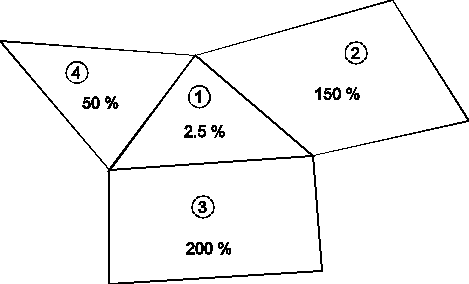
The change in the K value in element 1 is now calculated as the mean value:
calculated % change in element 1 and
mean % change in the neighbouring elements
As follows:

 The K value in element 1 is set to 67.92 % of 0.40 = 0.271.
For 3D models, the vertically adjacent elements are also included in the calculation in addition to the horizontally adjacent neighbouring elements. Consideration of "layering", i.e. areas with K values of different orders of magnitude (aquifers/aquitards) are also detected automatically and taken into consideration: Neighbouring elements with K values of other orders of magnitude are included in the weighting with smaller weighting factors.
Stand: 30.01.2025 | 