In many areas characterised by mining, the groundwater in built-up areas is now relatively close to the surface. In the case of existing buildings, groundwater rises that are harmful to the building fabric can often only be avoided by means of measures to regulate groundwater levels, such as polder wells. In contrast to abstraction wells, which are used for water extraction, the abstraction rates for local groundwater level control with polder wells are often unknown and therefore cannot be used as a boundary condition (KNOT = sources/sinks) in the model. Rather, the drawdown target is the main focus when using wells to regulate groundwater levels. The modelling approach typically used in SPRING for such a situation is described below.
The following diagram shows the problem schematically:
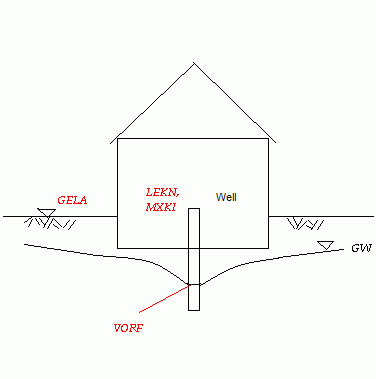
Diagram of a polder well in the basement of a building
VORF
The mesh node of the well is assigned a potential head whose value corresponds to the maximum permissible groundwater level (e.g. basement foundation - 0.80 m). In the case of a 3D model, depending on the vertical mesh discretisation, it may be necessary to assign a group of GLEI attributes to the nodes in the vertical area of the well. The watercourse stage height (as a proxy for the potential head) must then be set to one of these nodes.
LEKN
In addition, as with any node with a watercourse stage height, a leakage coefficient must be applied (here: LEKN). A very large node leakage acts like a fixed potential head and ensures that the drawdown target in the well (watercourse stage height) is achieved. If measured withdrawal rates are available for the well, the leakage coefficient can be calibrated by comparing the measured flow rate with the flow rate calculated by the programme. The calculated watercourse leakage rates can be imported into SPRING, for example, via Attributes  Import model data/result data..., (background file "aaa", "Leakage rates", desired attribute identification, e.g. Q-LK). The menu item Attributes Edit node can be used to read the watercourse leakage rate (in m³/node/TU) at the well node.
MXKI
If the groundwater level at the well is below the defined watercourse water level, the receiving water node releases water into the groundwater. To prevent this undesirable effect, infiltration into the groundwater must be prevented using the MXKI = 0.0 attribute (the maximum infiltration rate is limited to 0.0).
MXKE
To limit the withdrawal rate due to technical constraints (pump capacity), we recommend defining a maximum withdrawal at the watercourse node with the MXKE attribute (note the sign convention: A negative value must be entered here to limit the withdrawal rate!
Modelling of a drainage system
Stand: 18.04.2025 | 