If there is a large receiving watercourse in the modelled area or at the edge of the area, there is often direct contact with the groundwater. The water table elevation can then be applied as a fixed potential head (POTE) at the corresponding nodes. The resulting inflow or outflow rate is the mass flow rate. If the surface water receives water from the aquifer, this is referred to as exfiltration. If the surface water loses water to the aquifer, this is known as infiltration.
Smaller bodies of water usually have no direct groundwater contact. Due to bed sealing phenomena (colmation) or the formation of an unsaturated zone between the watercourse and the groundwater surface, the exchange flow is impeded.
The following pictures illustrate the individual terms in relation to the aquifer:
|
|
|
|
|
Exfiltration of groundwater into the water course |
Infiltration of the water course into the groundwater |
Infiltration with tear-off height |
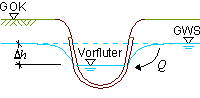
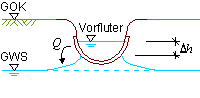
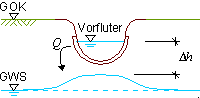
The direction of the exchange flow and the amount of water are expressed by a - usually linear - relationship between the water level in the surface water and the groundwater level and is referred to as the leakage function. The leakage coefficient [1/s] is the quotient of the infiltration or exfiltration rate Q (related to the width and length of a watercourse section) and the mean potential head difference. In practice, there is a maximum value for infiltration in particular, which is no longer exceeded even if the potential head difference is increased. However, a limit value can also be useful for exfiltration in certain cases.
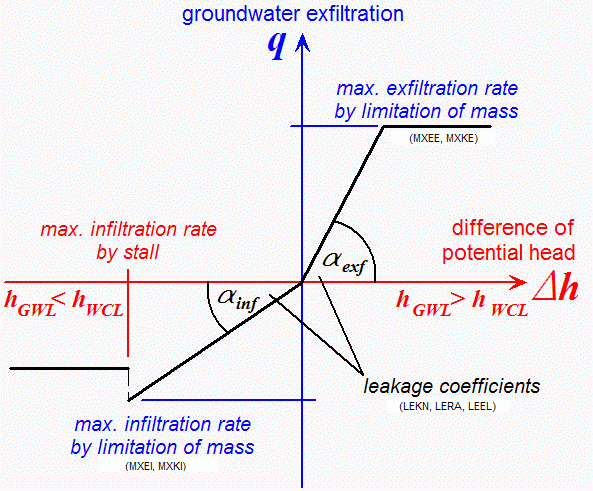
Basic illustration of the leakage function
A leakage relationship can be useful not only for a line-related watercourse, but also for areas. The following data types are available in SPRING for entering the leakage relationship
VORF: node-related elevation of the water level in the surface waters (watercourse stage)
ABRI: Water level difference between the watercourse stage and the groundwater level above which there is no further increase in the infiltration rate (tear-off elevation)
LEKN: Leakage coefficient of a node
LERA: Length-related leakage coefficient for a polyline
LEEL: Leakage coefficient for elements
LKFA: Ratio between exfiltration and infiltration at nodes (LEKN) or polygons (LERA)
LEFA: Ratio between exfiltration and infiltration in elements (LEEL)
MXKE: Maximum exfiltration rate for a polyline
MXEE: Maximum exfiltration rate for elements
MXKI: Maximum infiltration rate for a polyline
MXEI: Maximum infiltration rate for elements
In order for leakage to be taken into account, the data type VORF and one of the three data types LEKN, LERA or LEEL are mandatory.
Leakage relationship with impermeable layers
A special case of an areal leakage relationship is the exchange of water through a restricting or low-permeability layer. Although this layer above the aquifer hinders the rise of the groundwater (see maximum thickness of the aquifer), it still allows a conditional exchange of water - especially in the case of steady state observations.
The entries for this phenomenon are made using the following data types:
UNDU: Thickness of the impermeable layer (prerequisite is the input of the ground surface with GELA )
LEEL: The interpretation of the value depends on the input for UNDU: UNDU>0: LEEL = vertical K value of the impermeable layer in m/s; UNDU=0 or no input: LEEL = direct leakage coefficient in 1/time unit.
VORF: Water level of the watercourse (can be set to ground level if there is no open water surface)
In the following chapters, the practical implementation of individual watercourse interactions in the groundwater model is explained using typical examples.
 Spacing regulation through a polder well
Stand: 18.04.2025 | 