Data identifiers:
1DEL (1D fractures),
2DEL (2D fractures)
Model type: 1K, 2K
This identifier is used to define the 1D or 2D fracture elements by specifying their respective nodes. The fractures must be numbered, however, the numbering is arbitrary.
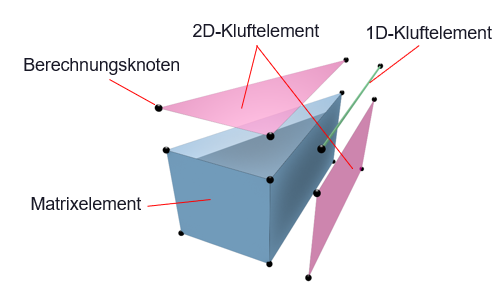
Possible types of fracture elements
For the definition of a fracture, the fracture number and the two- to four node numbers (that form the fracture) must be entered. For 2D fractures that only have three corner nodes, the 4th node is entered as 0. Two fractures can be defined per row in the model or 3D file (*.3d).
Columns 1 - 6: no. 1st fracture
Columns 7 - 12: 1st node no. 1st fracture
Columns 13 - 18: 2nd node no. 1st fracture
Columns 19 - 24: 3rd node no. 1st fracture (only for 2D fractures)
Columns 25 - 30: 4th node no. 1st fracture (only for 2D fractures)
Columns 37 - 42: no. 2nd fracture
Columns 43 - 48: 1st node no. 2nd fracture
Columns 49 - 54: 2nd node no. 2nd fracture
Columns 55 - 60: 3rd node no. 2nd fracture (only for 2D fractures)
Columns 61 - 66: 4th node no. 2nd fracture (only for 2D fractures)
Within a row, either the 1st or 2nd fracture description can be omitted. In other words, a row can have either one or two fracture definitions. One-dimensional fractures (1DEL) can currently only be created or displayed with the KLUFTI programme.
Stand: 09.10.2026 | 