In contrast to a horizontal model, the geometric elements to be captured in a vertical model lie in the vertical plane. However, a vertical model is constructed according to the same rules as a horizontal model. Typical examples of the use of a vertical model are dams, dam walls of reservoirs or a flow-relevant consideration of tunnel or pipeline cross-sections in the vertical plane.
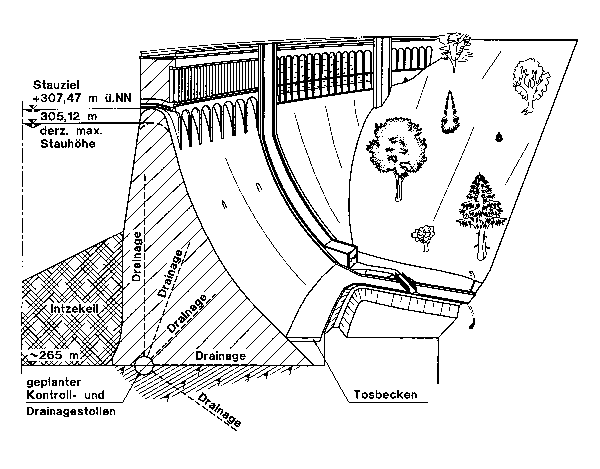
Cross-section of a dam wall
The discretisation of the above dam as a two-dimensional vertical model in SPRING is as follows:
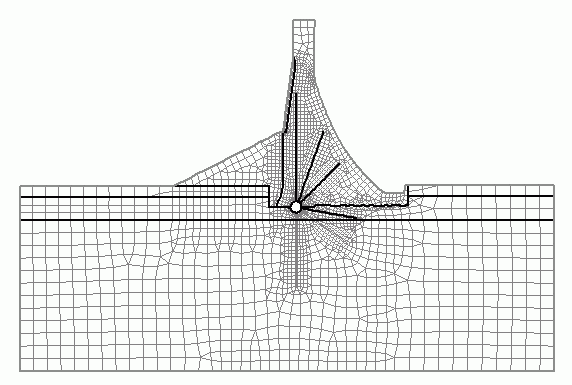
Discretisation of a vertical model in SPRING
To generate the 3D mesh, the 2D mesh is projected into the third dimension ("backwards"):
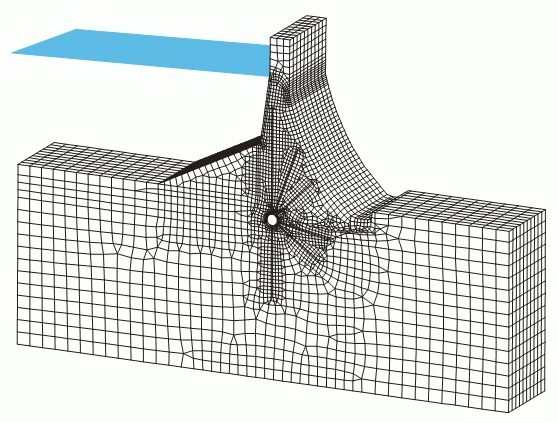
Discretisation of a vertical 3D model (model type V-3D)
In this case, the associated boundary conditions look like this:
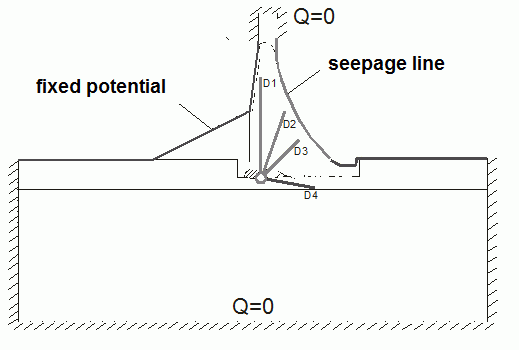
Boundary conditions of a dam wall
 Special features of the 2D vertical model
Stand: 25.01.2025 | 